
Fields in Sherman Tax Records
Sherman County property tax records split their facts among three offices. The Appraiser builds the parcel description and valuation. The Clerk keeps tax abstracts and real-estate ownership records. The Treasurer tracks the bill, payment, delinquency, and any tax-foreclosure trail. Reading all three keeps a value estimate from being mistaken for an amount due, and it tells you which office can fix a given field. The county's Appraiser page covers property record cards, CAMA ORION, appraisal methods, and a Parcel Search link, though the official page does not expose the live search fields itself.
| Field | What It Shows | Where |
|---|---|---|
| Appraised value | The office's estimate of fair market value as of January 1 | County Appraiser |
| Assessment class and rate | The statutory class and percentage used to convert appraised value | County Appraiser |
| Assessed value | The taxable value before the levy is applied | County Appraiser and Clerk |
| Tax districts and levy | The local taxing units and rates tied to the parcel | County Clerk and statement |
| Bill and status | Amount billed, payment, interest, or delinquency | County Treasurer |
Appraised value, assessed value, and sale price are not the same thing. Kansas applies classification rules and assessment percentages before any tax is calculated. A recorded deed may list a consideration amount. But that figure does not automatically become the appraised value. Sherman County's tax statement then applies the levy to the assessed value. Keep the valuation notice and tax statement from the same year. You will want them when you need a parcel-level answer. For statewide context, the Kansas Property Valuation Division publishes oversight material. The 2024 Sherman County class report shows a mix of agricultural, utility, commercial, oil and gas, and personal-property classes alongside residential real estate.
Sherman County January Valuation
Kansas law sets the valuation date at January 1 for real property. That fixed date shapes what a Sherman County appraisal record shows. A parcel may sell later in the year. It may change use or gain a building. The record still reflects January first. Think of it as a tax-year snapshot. It is not a running sale ledger. Sherman County appraisers walk the county on a six-year cycle, physically inspecting and relisting property. They may visit sooner after construction, demolition, or another reported change. The on-site parcel inspection notice describes how staff measure, photograph, and verify property characteristics. They never enter a residence without permission.
Each parcel carries a property record card, usually called a PRC. It can list the land description, class, and dimensions. Buildings, sketches, and features behind a CAMA valuation may appear too. CAMA stands for computer-assisted mass appraisal. It values groups of similar property under shared models rather than appraising one sale for a private fee. Before comparing any record against a current condition or a recent transfer, check its effective year.
Note: A six-year inspection cycle does not stop Sherman County from updating values or ownership fields in the meantime.
Classes Shape Sherman Property Tax
The state class report offers useful county context without pricing any single parcel. Sherman County's tax base includes agricultural land and improvements. It also covers public utilities, commercial realty, oil and gas, and personal property. A countywide average can mislead for that reason. The right route is to find the parcel's actual classification on the Appraiser record. Then match that class to Kansas valuation rules and the local levy for the same tax year.
- Appraised value
- The Appraiser's estimate of fair market value under Kansas standards.
- Assessed value
- The taxable portion produced after the statutory class percentage is applied.
- Mill levy
- A tax rate expressed as dollars per one thousand dollars of assessed value.
- Property record card
- The parcel-level description and characteristics used in mass appraisal.
Classification also works as a routing clue. A residence, a farm tract, utility property, and an oil-and-gas interest may each call for different supporting records. Ask the Appraiser which class was applied. Ask which subclass was applied too. Request the parcel card or model data behind the value. Never infer a class from a photograph or a mailing address.
Land and improvements may appear as separate components too. Review both before deciding why a total changed. A new structure can affect the record. A removed building, corrected square footage, a land-use shift, or a class change can each affect it differently. Ask which underlying characteristic changed. Ask its effective tax year. Ask which notice gave appeal rights. That builds a clear issue list for an informal review instead of a broad claim that the entire Sherman County property tax amount seems too high.
Look Up Sherman Tax Bills
The Sherman County Treasurer routes online payments through the Kansas property-tax gateway. That gateway requires a tax statement number or Tax ID pulled from the statement. It offers no countywide owner-name or street-address search. Begin at the Appraiser when only an address is known. Then obtain the account key the tax side needs. The official Kansas property-tax payment screen shows the statewide entry route. It is used for Sherman County tax records.
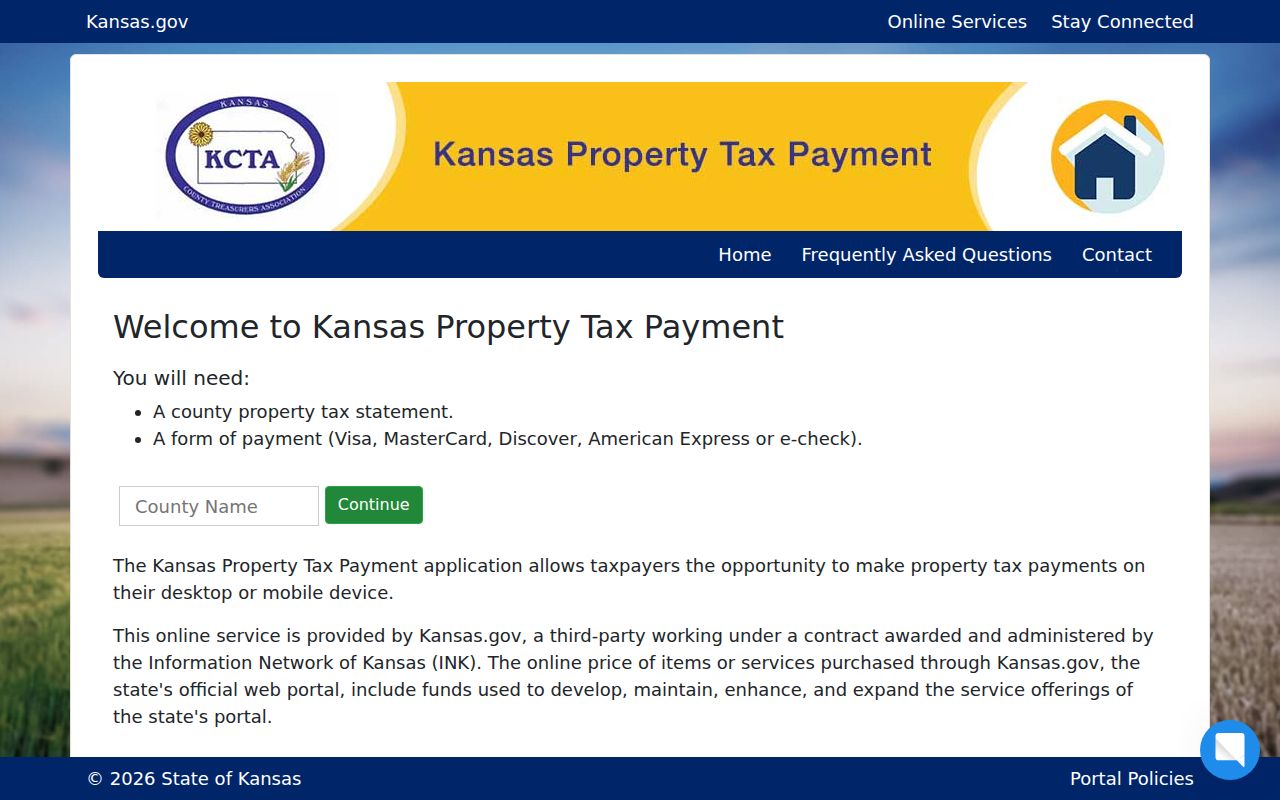
That payment screen is exactly why the statement number or Tax ID must be in hand before the lookup begins.
- Open the Appraiser's Parcel Search route and identify the parcel. Copy the entire number and legal description exactly as shown.
- Use the statement number or Tax ID at the Kansas property-tax gateway. Note any vendor fee before choosing card or electronic-check payment.
- Compare the tax year, assessed value, districts, amount due, and payment status. Keep a receipt separately from the search result.
- For an unclear balance, prior year, or missing statement, contact the Treasurer directly. Confirm whether interest, delinquency, publication, or foreclosure referral applies.
A mailing address on the statement can differ from the site's street address. Verify both. When an ownership change is recent, compare the newest recorded deed. Do not treat an old tax-mailing name as conclusive. The Treasurer's page also carries a caution. Failing to receive a statement does not remove the tax obligation.
Sherman Property Tax Delinquency
Unpaid real-estate tax leaves its own paper trail in Sherman County. The Treasurer's real-estate tax guidance walks through delinquency, publication, and referral toward foreclosure. Sale timing comes from the county's tax-foreclosure instructions. A sale date is announced four to six weeks ahead, and notices run in the Goodland Star-News or may be checked by phone. Remember that a published list is only a dated notice. It does not prove the parcel is still unpaid today.
A careful bid packet should capture the notice date, exact legal description, parcel or account identifier, redemption status, special assessments, zoning or building details, plat references, and the eventual deed record. The Treasurer points bidders to several offices. Special-assessment staff, city clerks, zoning and building offices, plat maps, and deed records each hold a piece. That five-stop check reveals what one payment screen cannot.
Verify before paying. Confirm every sale date, amount, and parcel with the Treasurer at the official county number. Do not treat a solicitation or wire request as a county bill.
Challenge Sherman Property Tax Assessments
An appeal targets the Appraiser's value or classification. It is not a protest of the Treasurer's arithmetic once a final value is certified. Open the valuation notice the day it arrives. Sherman County's Appraiser page lays out an informal meeting route and further appeal rights. No single permanent calendar date governs every notice, so trust the deadline printed on the current one. Contact the office promptly and ask which form and filing method apply.
Good evidence is parcel-specific. Bring the property record card, dated photographs, a corrected building description, credible comparable sales, repair estimates for condition problems, and any legal-description or class error. Name the exact field in dispute. A nearby asking price alone is weak. It may reflect a different class, condition, lot, or sale date. If the informal result disappoints, keep the written decision. Then follow the stated route to the county board and any later Kansas tax appeal.
Appeal window. Use the deadline on the current Sherman County valuation notice. The official research did not support substituting a generic annual date.
Request Missing Sherman Tax Records
When the online route fails, take the question straight to the office that owns it. The Appraiser supplies parcel characteristics, value support, and classification. The Clerk keeps the county's tax abstracts and real-estate ownership records, while bills, receipts, delinquency, and sale status belong to the Treasurer. Current contacts and hours appear in the county department directory. Ask by parcel number and legal description whenever possible.
Sherman County's Kansas Open Records Act procedure asks for a written request with your name, mailing address, phone number, and a detailed record description. Electronic format may be requested. The published charge is $0.25 per copied page, plus mailing, fax, staff, or other actual costs when applicable. Advance payment may be required first. The county must respond by the third business day. That response delivers the record, a time and cost estimate, or the legal reason for denial. KORA obtains records that exist. It does not create custom tax histories.
Note: Statewide valuation reports give context, but only the county's parcel file and tax account answer a parcel-level question.